
THE OPERATING QUESTION · ISSUE 01 · 15 SEP 2026
What have you decided against?
The second list is harder to produce. It may be the more useful one.
Business first. Technology where it earns its place.

Ask a leadership team what the business is working on and you get a list. Ask what it has decided not to do, and the second list is harder to produce.
That second list may be the more useful one. Not because good leadership means saying no more often, but because it makes the trade-off visible. A yes without an explicit alternative can easily become accumulation rather than prioritisation.
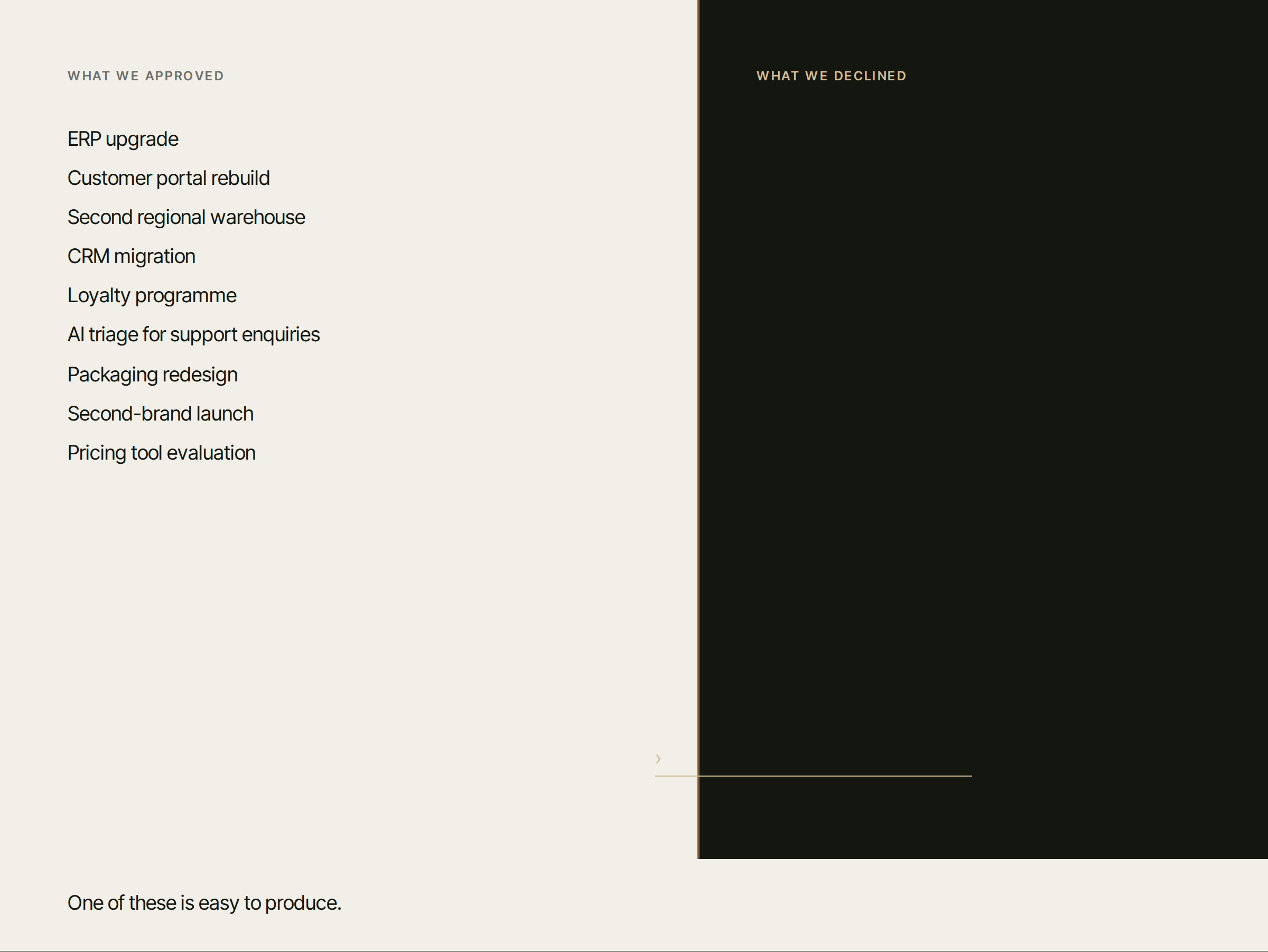
Ideas are rarely the binding constraint. Capacity is.
Every approved initiative spends four scarce things: senior attention, capable execution time, capital, and the organisation’s capacity for change. When everything is approved, those resources are committed repeatedly. That is how an initiative can end up technically live and practically dormant.
The evidence is close to hand. Count the formal approvals in your last four leadership meetings against the formal declines. Then find the initiatives that have neither started nor stopped for two quarters. They are neither active nor closed. Until a decision is recorded, they can continue to occupy a slot, a sponsor and a line in the update pack without returning anything.

Three states, not two.
“Not yet” is useful only when it carries a written condition and a review date. Without both, it becomes a parking bay, and the proposal can return later with a new sponsor and no record of why it was set aside.
Keep the operating record to one line: what was declined, why, who decided, on what date, and what would have to be true to reopen it. A one-line record is easier to maintain and retrieve.
THE ONE-LINE DECISION RECORD
Proposal · Decision · Why · Owner · Reopen when · Review date
Illustrative example
AI support triage · NOT YET · CRM data inconsistent · COO · agreed data-quality condition met · 15 Dec
AI has lowered the cost of generating plausible ideas. It has not lowered the cost of management attention. Vendors, internal teams and advisers can put forward candidate use cases quickly; evaluation, workflow redesign, governance, adoption and accountability still consume scarce organisational capacity.
The useful output of a review may therefore be a shorter list. Do not proceed is a legitimate management answer, not an absence of ambition.
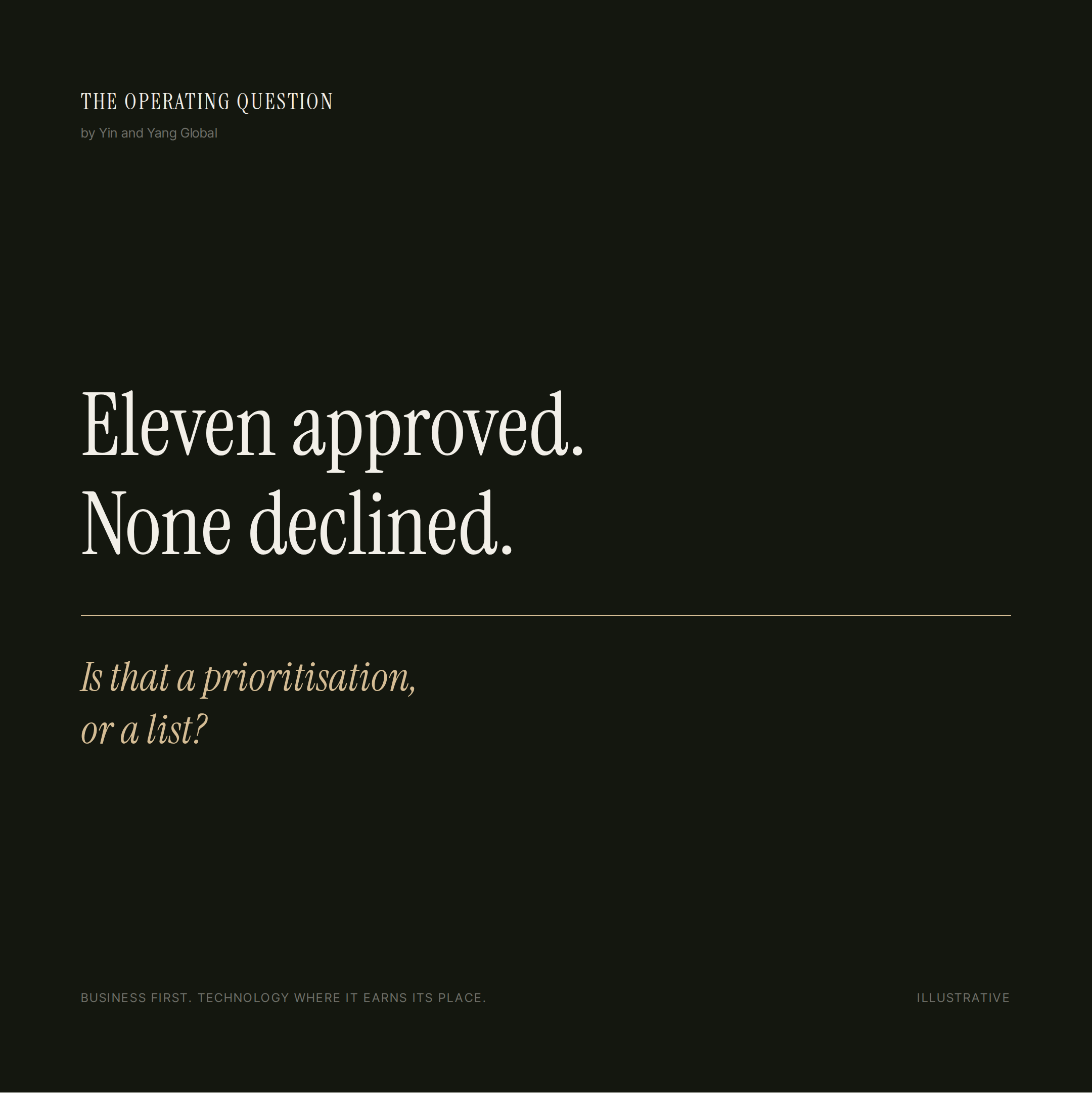
The outcome is not a longer governance process.
It is a smaller live agenda, clearer ownership and more management attention behind the things that actually matter. Keep a dated record of what you turned down, so that when it returns, the conversation starts from what you already concluded.
WHAT TO CHECK THIS WEEK
Three checks for the leadership team.
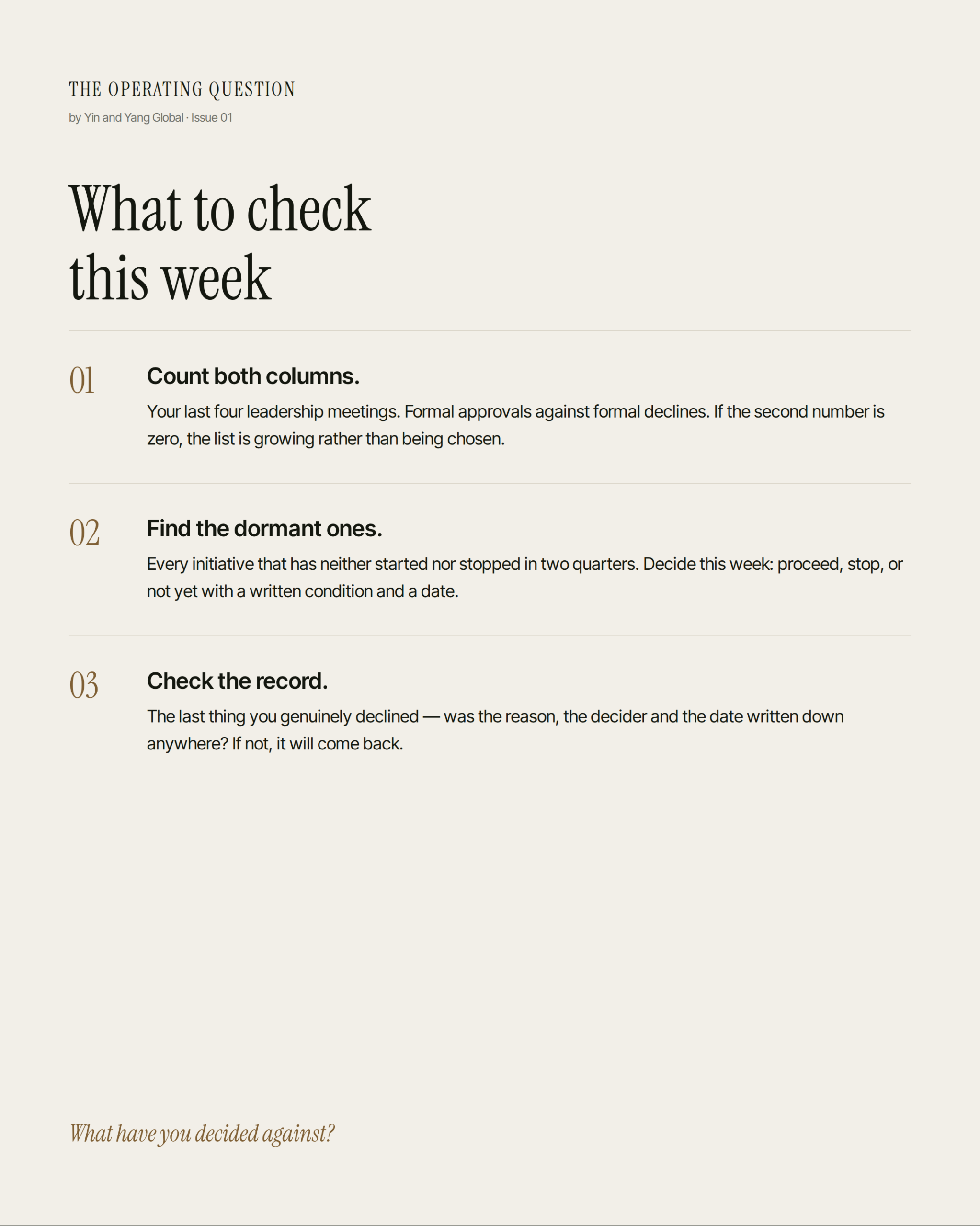
01 · Count both columns. Look at your last four leadership meetings. Count formal approvals against formal declines. If the second number is zero, ask whether priorities are actually being chosen — or simply accumulated.
02 · Find the dormant ones. Every initiative that has neither started nor stopped in two quarters. Decide this week: proceed, stop, or not yet with a written condition and a date.
03 · Check the record. Take the last thing you genuinely declined. Can someone retrieve the reason, the decider, the date and the condition for reopening it? If not, the organisation has no durable decision record.
FEATURED SOLUTION
AI Decision & Governance for Leaders
A one-day programme that takes a leadership team through the decision on each of its AI candidates — proceed, stop, fix foundations first, test, investigate further, or transform.
Problem: AI initiatives accumulating without clear trade-offs, decision conditions or accountability.
For: Chief executives, founders, functional heads and leadership teams.
Outcome: A decided agenda — priority use cases owned, governed and measured, with a 90-day management agenda.
2-MINUTE AI-LED PERFORMANCE DIAGNOSTIC
Where might AI improve performance — and where might it not earn its place?
A free, automated, directional preview of where AI may improve business performance — and where it may not earn its place.
This is the first issue of The Operating Question.
It arrives every Tuesday: one management question, worked through properly.
If there is a question you are sitting with — the one that keeps getting half-answered in your leadership meeting — reply and send it. I read every reply, and it may well become an issue.
Aditi Vohra
Founder & Principal Consultant
Yin and Yang Global
The Operating Question is a private weekly management note from Yin and Yang Global.
Written for founders, CEOs, CXOs and senior business leaders. Complimentary access.