
THE OPERATING QUESTION · ISSUE 03 · 29 SEP 2026
Would you build it this way today?
Before you automate a workflow, ask whether it should still exist.
Business first. Technology where it earns its place.
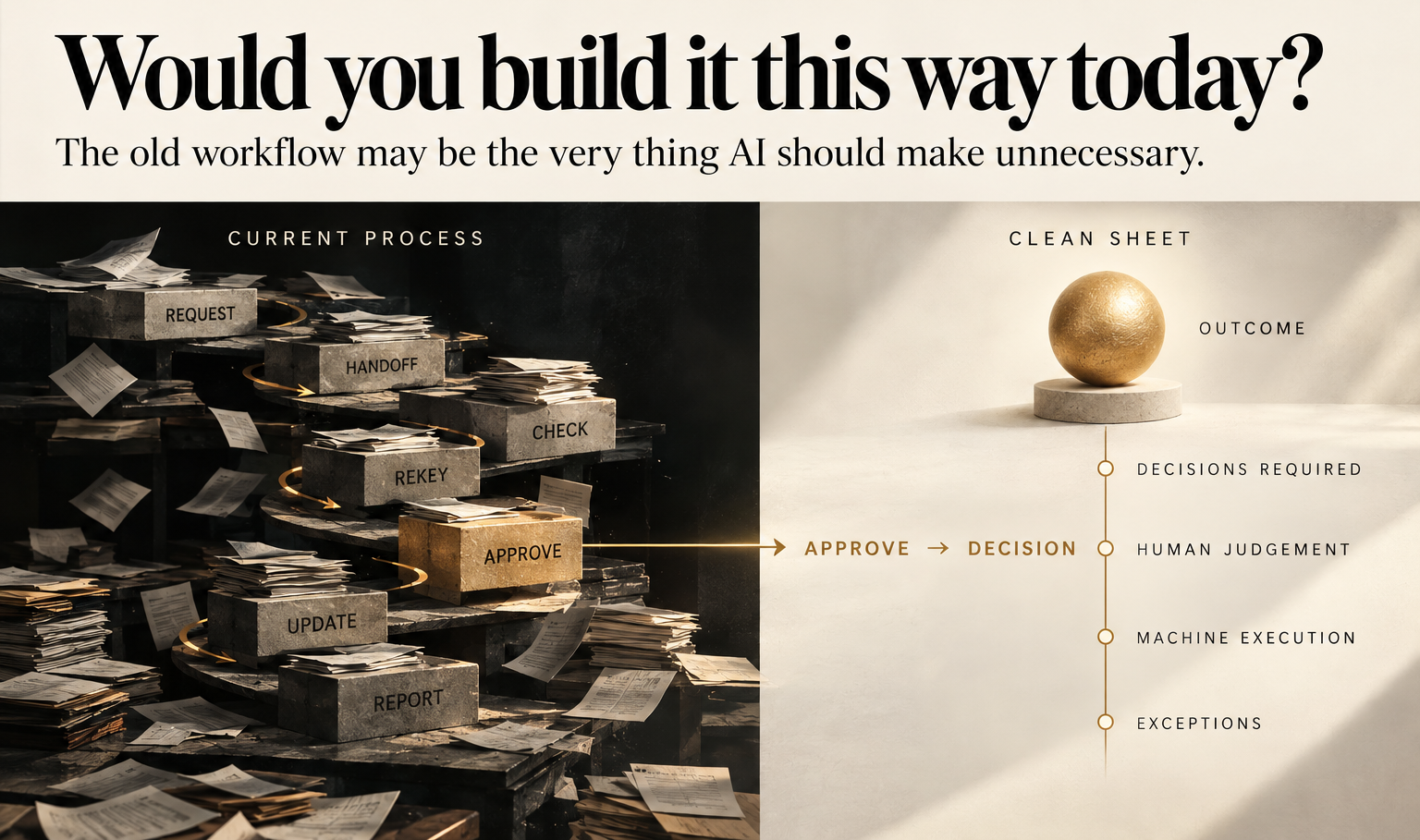
The easiest way to improve a process is to make each step faster. With AI, that has never been easier.
Map the workflow. Automate the repetitive parts. Remove a few minutes here, an hour there.
But that approach starts by accepting the existing workflow as correct.
A report may pass through six hands because information once moved manually. An expense exception may require three approvals because nobody had real-time visibility. A weekly status meeting may exist because the underlying information could not be assembled continuously.
Make each step faster and you may simply preserve the constraint that created it.
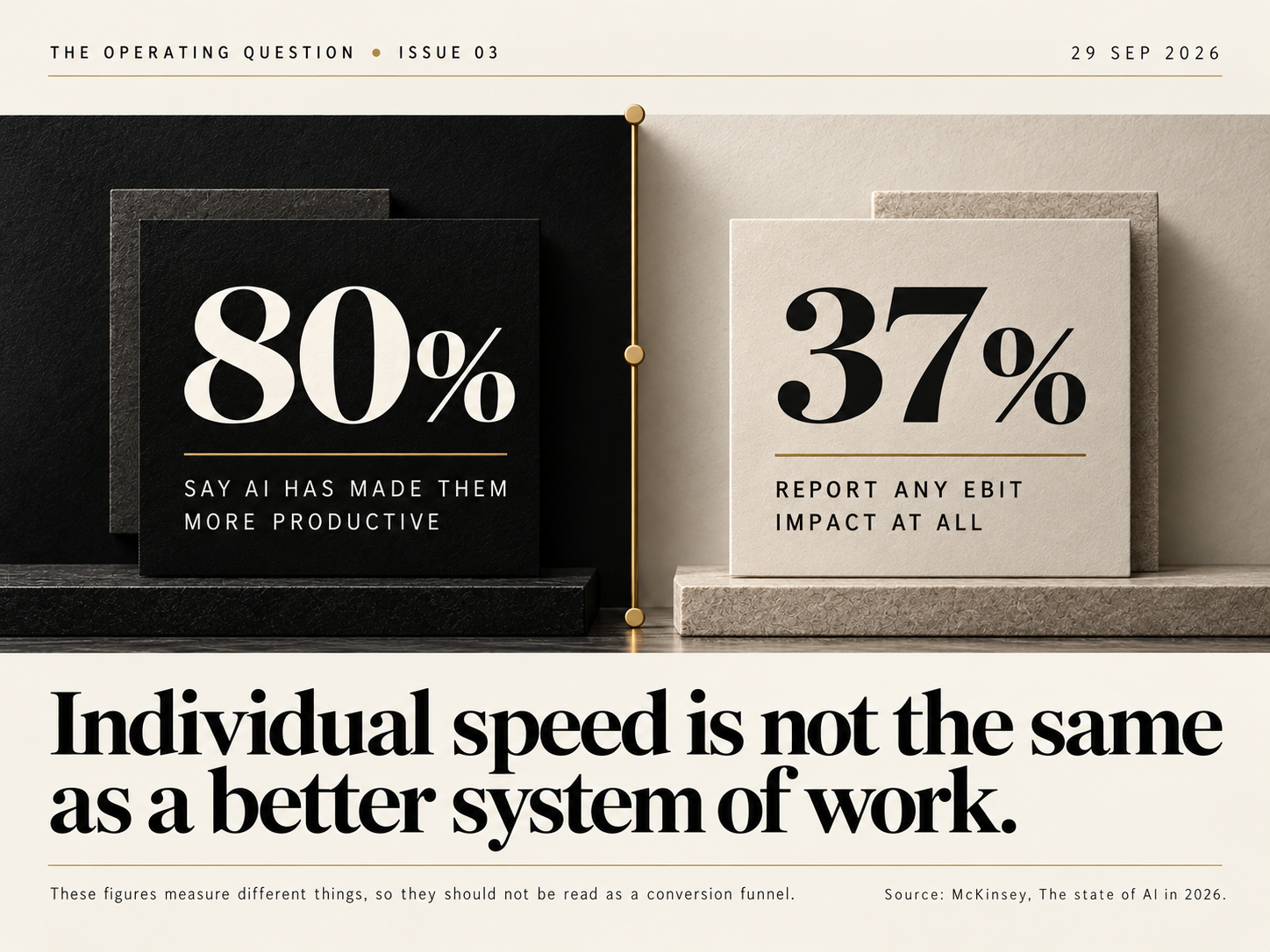
Those figures measure different things, so they should not be read as a conversion funnel. They do not prove workflow design is the cause. They are a useful warning: individual productivity is a weak proxy for enterprise value.
McKinsey’s recent work on the “coordination tax” points to the spaces between tasks — hand-offs, queues, rekeying, checking and cross-functional coordination — as a major opportunity for redesign.
McKinsey’s separate work on scaling agentic AI names automating broken processes instead of redesigning them as one of the recurring failure patterns.
So before asking where can AI enter this process?, ask the more basic question: if we were creating this workflow today, would we build it this way at all?
THE CLEAN-SHEET WORKFLOW
Outcome → Decisions required → Human judgement → Machine execution → Exceptions → Owner → Measure
ILLUSTRATIVE EXAMPLE
Purchase-order exception → approve / query / escalate → judgement on commercial exception → system checks agreed price, tolerance and history → out-of-policy or high-value exception → Procurement Head → resolution time + value recovered
Start with the outcome, not the existing process map. Rebuild backwards: what decision has to be made, what genuinely requires human judgement, what can a machine execute, what counts as an exception, who owns the result, and what measure tells you the redesign worked?
WHAT TO CHECK THIS WEEK
Three checks for the leadership team.
01 · Count the hand-offs.
Take one recurring process and count every time work changes hands. For each hand-off, ask what information, authority or capability is missing that makes the transfer necessary.
02 · Test your approvals.
List every approval in the workflow. For each, ask: when did this approval last change an outcome? An approval that never changes anything is a queue with a signature.
03 · Challenge one recurring meeting or report.
Ask: if the underlying information were continuously visible, would this meeting or report still need to exist in the same form?
THE LEADERSHIP QUESTION
Are we using AI to improve the way work gets done — or to preserve the way work used to get done?
FEATURED SOLUTION
Workforce & Productivity Intelligence
A focused 21-day engagement that identifies workflow bottlenecks, queues, hand-off friction, rework and capacity constraints so management can improve business output before adding headcount or automation.
2-MINUTE AI-LED PERFORMANCE DIAGNOSTIC
Where might AI improve performance — and where might it not earn its place?
A free, automated, directional preview of where AI may improve business performance — and where it may not earn its place.
If there is a question you are sitting with — the one that keeps getting half-answered in your leadership meeting — reply and send it. I read every reply.
Aditi Vohra
Founder & Principal Consultant
Yin and Yang Global
Evidence note: McKinsey — The state of AI in 2026 (25 Aug 2026) · McKinsey — Cutting the ‘coordination tax’ (18 Sep 2026) · McKinsey — Stacking the odds (14 Sep 2026)