

THE OPERATING QUESTION · ISSUE 04 · 6 OCT 2026
Expansion plans are precise about targets and often silent about authority.
Business first. Technology where it earns its place.
Most expansion plans are specific about the number: the revenue target, the launch date, the headcount, the investment, the first locations.
They are often much less specific about authority.
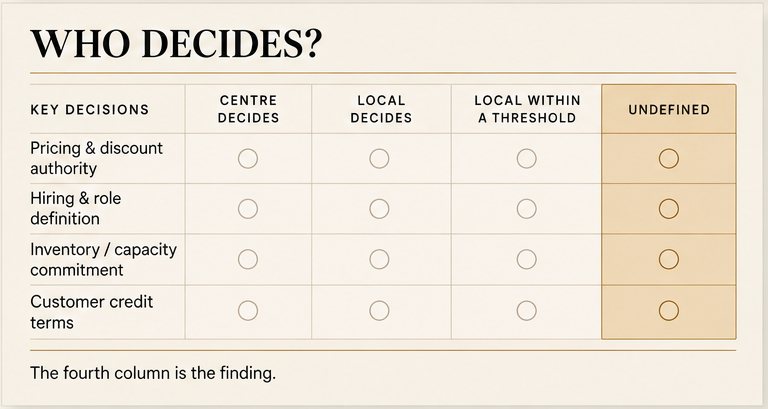
Who can change a price? Who can approve a role? Who can commit inventory or capacity? Who can extend a customer credit term when the answer needs to be given today, not after the next central review?
When those rights are undefined, the local team does not really have autonomy and the centre does not really have control. What it has is a queue.
The useful question is not whether the business should be centralised or decentralised. That is too abstract.
The useful question is: for this decision, in this market, who decides — and within what threshold?
A clear threshold is often more valuable than a broad statement about empowerment. “Local decides discounts up to X; centre approves above it” can be operated. “Commercial decisions are made collaboratively” cannot.
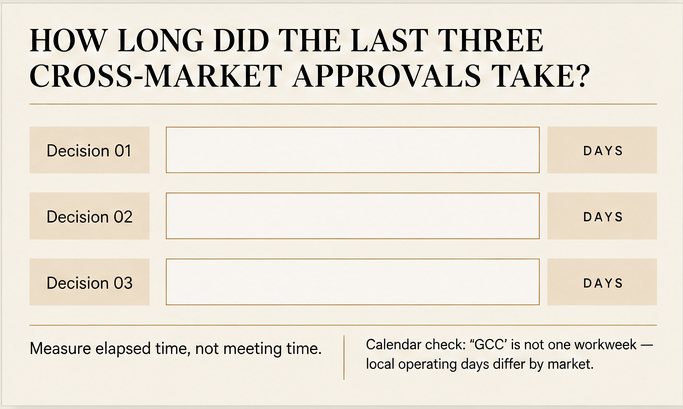
Then measure the delay that ambiguity creates. Take the last three decisions that crossed markets and record elapsed time from request to answer. Do not measure meeting time. Measure calendar time.
And check the calendar itself. “GCC” is not one workweek. Qatar’s official working days run Sunday to Thursday. The UAE federal government works full days Monday to Thursday and until noon on Friday, while Sharjah government works Monday to Thursday. A central reporting rhythm that assumes one calendar across every market can create a delay before anyone has made a decision.
Expansion plans are precise about targets and often silent about authority. The second one is what stalls them.
WHAT TO CHECK THIS WEEK
01 · Name the decider.
For pricing and discounts, hiring and roles, inventory or capacity commitments, and customer credit terms: who decides in the other market? If the answer is “it depends”, write the threshold.
02 · Measure the last three approvals.
Count elapsed calendar time from request to answer. The number exposes the operating cost of an undefined decision right.
03 · Check the calendar by market.
Do not assume one India–GCC reporting rhythm. Write down the actual operating days, weekly review day and escalation window for each market.
THE LEADERSHIP QUESTION
FEATURED SOLUTION
A focused 10–15 working-day assessment for Indian businesses evaluating the GCC, or GCC companies considering India. We examine market-entry objectives, central-versus-local responsibilities, reporting and decision structures, localisation needs, dependencies and execution risks.
2-MINUTE AI-LED PERFORMANCE DIAGNOSTIC
A free, automated, directional preview of where AI may improve business performance — and where it may not earn its place.
If there is a cross-market decision that keeps returning to the same meeting, reply and send it. I read every reply.
Aditi Vohra
Founder & Principal Consultant
Yin and Yang Global
Calendar evidence: Qatar Legal Portal — Amiri Decision No. 57 of 2025 · UAE Government